China’s Proxy Conflicts: Is World War III Upon Us?
By Gordon G. Chang (Gatestone Institute)
* By not adopting resolute approaches, the United States and partners have allowed bad actors to bring the world closer to global conflict.
* Xi is apparently trying to “encircle the cities from the countryside.” Today, the Chinese leader considers places like Ukraine to be countryside and America the most important city.
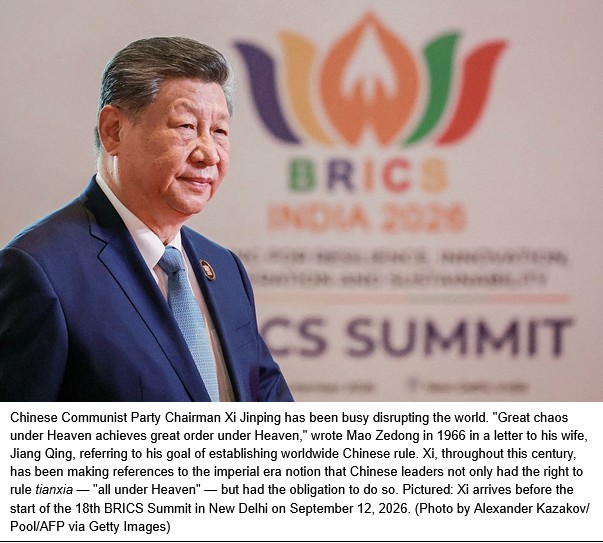
* Xi has been busy disrupting the world. “Great chaos under Heaven achieves great order under Heaven,” wrote Mao Zedong in 1966 in a letter to his wife, Jiang Qing, referring to his goal of establishing worldwide Chinese rule. Xi, throughout this century, has been making references to the imperial era notion that Chinese leaders not only had the right to rule tianxia — “all under Heaven” — but had the obligation to do so.
* America has to confront the Chinese state wherever the Chinese state confronts the world. Every fight — Xi Jinping is now waging proxy wars on three continents — has therefore become critical if not part of an existential struggle.
* China and Russia have not chosen to fight the United States directly since the Korean War, but they are getting close, in both Ukraine and Iran. Both conflicts now are proxy contests.
* In the late 1930s separate wars merged into what we now call World War II.
* “The question may therefore be not whether World War III is imminent but how many simultaneous regional wars can occur before the distinction between regional conflict and world war loses strategic meaning.” — David Maxwell, vice president of the Center for Asia Pacific Strategy, to the author, September 2026.
“No, we are not on the eve of World War III,” writes Leon Hadar in Asia Times.
“What’s actually happening in 2026 is not the slow ignition of a single global war,” he adds. “It’s the slow unwinding of the postwar America-led order, playing out simultaneously in half a dozen theaters that don’t yet cohere into one fight.”
Whether Hadar is correct or not, a friend mentioned in June that “the world is all out of control.”
In our out-of-control world, the pace of change is accelerating. As Vladimir Lenin reportedly said, “There are decades when nothing happens, and there are weeks when decades happen.”
In this period of rapid change, Hadar admits there are regional wars but finds them “a symptom of disorder rather than a step toward global war.”
“The danger in over-diagnosing ‘World War III’ isn’t just inaccuracy,” Hadar argues. “It’s that the framing tends to produce the very policies—maximalist commitments, reflexive military posturing, treating every regional dispute as an existential test of resolve—that make the smaller fires harder to put out.”
This reasonable-sounding view misses a bigger point. By not adopting resolute approaches, the United States and partners have allowed bad actors to bring the world closer to global conflict.
Russian President Vladimir Putin, for instance, almost certainly perceived American and Western indecision in early 2022 — President Joe Biden said he might tolerate a “minor incursion” into Ukraine — as a green light for a full-scale invasion.
If Biden had instead made the invasion “an existential test of resolve,” he probably would have stared down the Russian leader. Instead, his feeble approach opened the door to a long-running war.
Ukraine matters, far more than most realize. As Gregory Copley, president of the International Strategic Studies Association, told Gatestone in December 2023, there are no more “regional wars” because “all of them have some degree of involvement by the great powers.”
In Ukraine, for instance, China has provided across-the-board support for Russia.
Xi Jinping has fully backed Putin because the Chinese leader has evidently taken two pages from Mao Zedong’s “peasant movement” playbook.
First, Xi is apparently trying to “encircle the cities from the countryside.” Today, the Chinese leader considers places like Ukraine to be countryside and America the most important city. Mao prevailed with that countryside-cities strategy in 1949 against the superior forces of Chiang Kai-shek’s Nationalists.
Second, Xi has been busy disrupting the world. “Great chaos under Heaven achieves great order under Heaven,” wrote Mao Zedong in 1966 in a letter to his wife, Jiang Qing, referring to his goal of establishing worldwide Chinese rule. Xi, throughout this century, has been making references to the imperial era notion that Chinese leaders not only had the right to rule tianxia — “all under Heaven” — but had the obligation to do so.
America has to confront the Chinese state wherever the Chinese state confronts the world. Every fight — Xi Jinping is now waging proxy wars on three continents — has therefore become critical if not part of an existential struggle.
“A genuine world war requires great powers choosing direct confrontation with each other,” Hadar writes. “What we have instead is several great and middle powers each pursuing narrower, more transactional aims, occasionally colliding, usually not on purpose.”
It’s true that China and Russia have not chosen to fight the United States directly since the Korean War, but they are getting close, in both Ukraine and Iran. Both conflicts now are proxy contests.
“World wars are often recognizable with certainty only after interconnected crises have become one conflict,” David Maxwell, vice president of the Center for Asia Pacific Strategy, wrote to me this month. “Separate wars need not begin as a coordinated global struggle.”
Maxwell is right: In the late 1930s separate wars merged into what we now call World War II.
As he notes, “The question may therefore be not whether World War III is imminent but how many simultaneous regional wars can occur before the distinction between regional conflict and world war loses strategic meaning.”
Today, both Russia and China have motives to fight to the end, Russia because it is losing badly in Ukraine and China because it faces internal crises that can end Communist Party rule.
The risk now is that a desperate Putin or an insecure Xi could use his most powerful weapons as he fights what becomes history’s last war.
Wars and rumors of wars….
As he sat on the Mount of Olives, the disciples came to him privately, saying, “Tell us, when will these things be, and what will be the sign of your coming and of the end of the age?” And Jesus answered them…
…And when you hear of wars and tumults, do not be terrified, for these things must first take place, but the end will not be at once.”
Then he said to them, “Nation will rise against nation, and kingdom against kingdom. There will be great earthquakes, and in various places famines and pestilences. And there will be terrors and great signs from heaven. ~ Jesus (Luke 21:9-11 & Matthew 24)
Things that continue to make me go Hmmmm…See my very relevant blog post 🤔👇
Scroll to this 👇 part and click the underlined dreams/vision link….
“It is proving that it could very well be “when the bombs start to fall down then we go up” kind of scenario that *many believer’s dreams and visions have revealed* after all. Including my own.”
* World War 3 On The Horizon. Bombs Fall Down We Go Up? *
Time is fleeting…TODAY is the BEST day for your salvation!!!! 👇👇👇